


School Zone Driving Guide for Melbourne Learners
A school zone can look quiet one moment and change completely the next. A child may step off the kerb to meet a parent, a car door may open beside a bus, or a crossing supervisor may raise the flags. This school zone driving guide is designed to help Melbourne learners recognise those changes early and respond calmly, safely and legally.
For learner drivers, school zones are also a good test of the habits that matter everywhere: looking well ahead, managing speed before a hazard, checking mirrors and leaving space for people to make unpredictable choices. The goal is not simply to get through the zone without making a mistake. It is to show patience and awareness when other road users need it most.
What makes school zones different?
School zones are marked areas around schools where a reduced speed limit applies at the times shown on the signs. In Victoria, many school zones operate at 40 km/h on school days, usually during morning and afternoon drop-off and pick-up periods. However, you must always read the signs at the location. The days and times displayed are what apply.
Do not assume the reduced limit ends when the school grounds look empty. If the sign says the zone is active, it is active. Equally, do not drive at 40 km/h unnecessarily outside the signed times if the normal posted speed limit is higher and conditions allow. Safe driving means reading the road, not relying on memory.
The lower limit gives everyone more time to react. Children can be hard to see between parked vehicles, may cross without checking properly, and can change direction quickly. Parents may be focused on children rather than traffic, while buses, delivery vehicles and busy drop-off areas can block your view.
School zone driving guide: the approach matters
A safe school-zone entry begins before you reach the sign. Look well ahead for fluorescent signs, crossing flags, groups of pedestrians, queued traffic and parked cars. Ease off the accelerator early so you can reduce speed smoothly rather than braking sharply at the last second.
Check your rear-view mirror as you slow down. This tells you whether a vehicle behind is following closely and helps you brake in a controlled way. You should still obey the speed limit even if another driver appears impatient. Being tailgated is not a reason to rush through an area where children may be crossing.
Once inside the zone, keep your eyes moving. Look ahead, check both sides of the road, and use your mirrors regularly. Avoid locking your attention onto the car directly in front. If it stops suddenly, you need to understand why before deciding whether it is safe to move around it.
A useful habit is to ask yourself: where could a person appear from? In a school zone, the answer is often from behind a parked car, near a bus, at a driveway, beside a crossing or through a gap in the traffic.
Leave room around parked vehicles
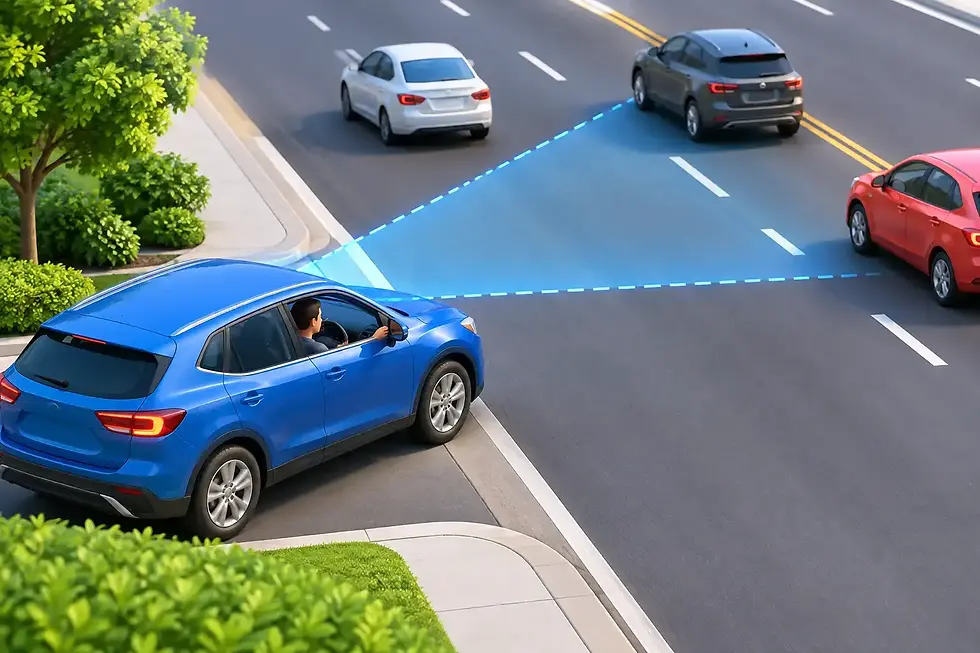
Cars stopping briefly for drop-off can create tight spaces and poor visibility. Reduce speed further if needed and give parked vehicles room where it is safe to do so. Watch for reverse lights, opening doors and people stepping out from the kerbside.
Never assume a driver has seen you just because they are indicating or waiting to pull out. A quick glance at their wheels can sometimes give an early clue that their vehicle is about to move, but continue to scan for pedestrians around the vehicle as well.
If the road is narrow, be prepared to wait rather than squeezing through. A learner driver who waits safely is making a sound decision, not holding up traffic.
Watch buses carefully
Buses deserve extra attention near schools. Children may walk around the front or rear of a bus, where they are difficult to see. Do not overtake a stopped bus unless it is clearly legal and safe, and never rush around it simply because you cannot see why it has stopped.
Keep a safe following distance so you have a clear view of the road ahead. If the bus blocks your vision of a crossing or pedestrian area, slow down and wait for the view to open up.
Children’s crossings and school crossings
A children’s crossing is not just another marked crossing. When the flags are displayed, drivers must follow the lower speed requirement shown and be ready to stop. A crossing supervisor may be helping children cross, particularly at busy times.
Approach every crossing at a speed that allows you to stop smoothly if someone steps onto it. Scan the footpath on both sides, not only the person closest to the kerb. A child who appears to be waiting may suddenly follow a friend across.
If pedestrians are crossing, stop and wait until they have safely cleared your path. Do not edge forward to pressure people to move faster. At a supervised crossing, follow the supervisor’s directions and remain patient until it is safe to proceed.
At traffic lights near schools, be especially alert for late crossings. A green light gives you permission to proceed only when the intersection is clear. Before turning, check for pedestrians crossing the road you are entering, including those who may be finishing their crossing after the signal has changed.
Common mistakes learners can avoid
Many school-zone errors happen because a learner is concentrating on one task and misses the bigger picture. Speed signs, pedestrians, parked cars and other traffic all need attention. The answer is not to stare harder at one thing, but to build a calm scanning routine.
One common mistake is braking late for the 40 km/h sign. Start slowing before the sign where safe, so you are at the required speed as you enter the zone. Another is focusing on the speedometer for too long. Check your speed regularly, then return your vision to the road ahead.
Learners can also be tempted to follow the vehicle in front too closely. Leave enough space to see past it where possible and to stop without harsh braking. If the driver ahead makes a poor choice, such as moving through a crossing too quickly, do not copy them.
Other mistakes to avoid include:
assuming the zone is inactive because there are few children visible
passing a stopped vehicle without checking why it has stopped
turning without looking for pedestrians on the road you are entering
accelerating too early before the end-of-zone sign
becoming flustered when another driver waits close behind you
How school zones are assessed in a driving test
During a driving test, an assessor is looking for safe, legal and independent driving. A school zone gives you an opportunity to demonstrate that you notice signs, choose an appropriate speed and respond properly to developing hazards.
You may be assessed on more than whether your speed stays below the limit. Your observation matters. Are you looking towards crossings before you arrive? Do you check mirrors before slowing? Can you hold your lane position around parked cars without drifting or rushing? Are your turns controlled when pedestrians are nearby?
There is no benefit in driving overly slowly when the road is clear if it causes confusion or holds up traffic unnecessarily. The right speed depends on the posted limit and conditions. On a busy pick-up afternoon, travelling well below the limit may be sensible. On a clear road during an active zone, maintain a steady legal speed while continuing to scan.
If you make a small error, such as needing to correct your speed gently, stay focused. Do not let one moment distract you from the next hazard. Calm recovery is part of safe driving.
Practising school-zone driving with purpose
The best practice is done at different times and in different conditions. Drive through a school area during an active period with a qualified supervising driver or instructor, then return outside the signed hours to practise reading the signs and adjusting to the normal limit.
Talk through what you can see. Identify the school-zone signs, parked cars, crossing points and possible pedestrian paths. This helps turn observation into a repeatable habit rather than a last-minute reaction.
For learners preparing for a VicRoads test in Melbourne’s eastern and south-eastern suburbs, local practice can be particularly helpful because school areas, busy shopping strips and residential streets often sit close together. An experienced instructor can help you practise the timing of mirror checks, gentle braking and hazard scanning in the kinds of environments you may meet on test day.
Yes Select Driving School can tailor lessons around the skills that need more attention, whether that is approaching crossings, managing busy traffic or building confidence in unfamiliar school areas. Give it a go and then make up your mind.
The strongest school-zone drivers are not the ones trying to impress anyone. They are the ones who notice early, slow down smoothly and give children, families and other road users the time and space they need.


Comments