

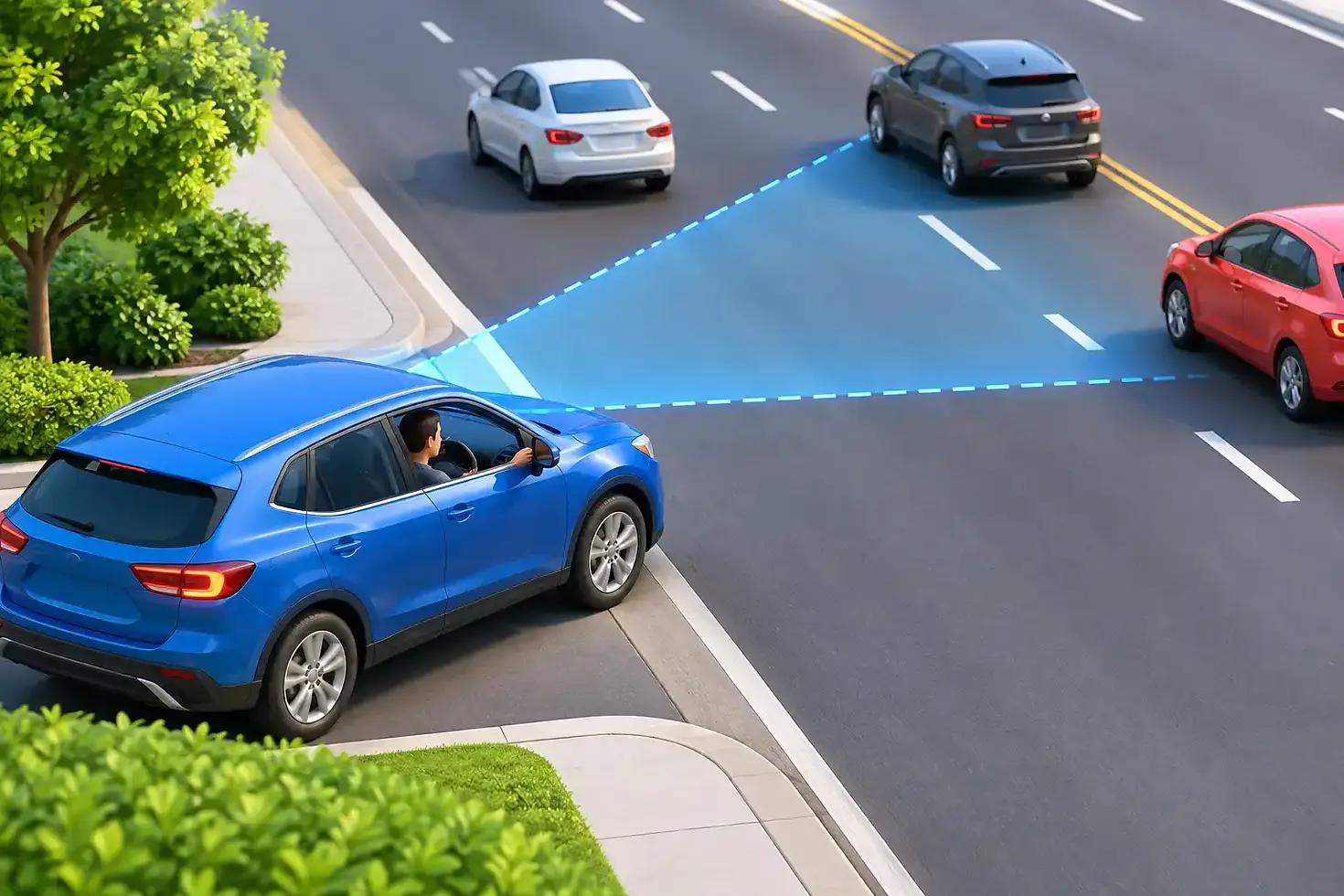
How to Judge Traffic Gaps Before You Pull Out
That moment at the end of a side street can feel much longer than it is. Your indicator is on, cars are coming from both directions, and the driver behind you may be waiting. The key to how to judge traffic gaps is not being brave or quick. It is learning to recognise when you have enough time to complete the move safely, without making another road user brake, swerve or guess what you will do.
A good gap is one you can take calmly. If you feel rushed, cannot see clearly, or would need strong acceleration to make it work, waiting is usually the safer choice. A few extra seconds is never worth a close call.
How to judge traffic gaps using time, not distance
Many learners look at an approaching car and ask, “Is it far enough away?” Distance matters, but time is more useful. A vehicle can look far away and still arrive very quickly if it is travelling at 70 km/h or more. A car that is closer may be safe to go in front of if it is moving slowly in congested traffic - but only if you have a clear view and can move smoothly.
Start by watching the traffic flow before you need to move. Notice whether vehicles are travelling at a steady pace, slowing for lights, coming around a bend, or accelerating after a roundabout. This gives you a better sense of their true speed than one quick glance.
Then ask yourself one practical question: if I move now, will I be fully established in my lane, or fully clear of the intersection, before that vehicle reaches me? If the answer is uncertain, do not go. You should not rely on an approaching driver slowing down to create space for you.
This is why instructors often talk about a “comfortable gap” rather than a fixed number of car lengths. There is no single gap that suits every road. The right amount of space changes with speed limits, wet roads, visibility, the power of the vehicle, the width of the road and the direction you need to travel.
Build a simple decision routine
Traffic-gap decisions become easier when you use the same routine each time. First, look far enough ahead to identify the traffic that may affect you. Next, check for pedestrians, cyclists and scooters close to your path. Finally, make your decision and commit to it only when the path is genuinely clear.
Avoid repeatedly inching forward and then stopping if you can help it. Creeping may improve your view at some intersections, but it can also place the front of your vehicle into the path of traffic or onto a pedestrian crossing. Move forward slowly only as far as needed to see, while still giving way as required.
Once you have chosen a safe gap, accelerate positively and steer smoothly. Hesitating halfway through a turn can make the situation less safe because it leaves you exposed for longer. Positive acceleration does not mean speeding. It means getting the vehicle moving efficiently and predictably.
If you miss a gap, let it go. Learner drivers sometimes feel they need to take the next available chance because traffic behind them is waiting. The driver behind cannot properly judge what you can see, how confident you feel, or whether a pedestrian is about to step out. Your responsibility is to make a safe decision, not to satisfy their impatience.
Turning right across traffic
Right turns across oncoming traffic are one of the most demanding situations for learners. You need to assess approaching vehicles, check for pedestrians crossing the road you are entering, and make sure there is enough room on the far side to finish the turn. At busier intersections, there may also be vehicles turning from the opposite direction.
Position your vehicle correctly, indicate early and keep your front wheels straight while you wait. Turning your wheels to the right before you move can push you into oncoming traffic if another vehicle hits you from behind.
Do not judge the gap only by the nearest oncoming car. Look beyond it. Is there another vehicle close behind it? Is a motorcycle approaching that is harder to spot? Is the next vehicle indicating left, and have they begun slowing enough to show that they really will turn? An indicator by itself is not a guarantee. Wait until the other driver’s speed and position clearly support what their indicator is telling you.
You also need enough space after the turn. Pulling into a street where parked cars, queued traffic or a narrow lane will immediately block you can leave part of your vehicle exposed in the intersection.
Roundabouts need early observation
At a roundabout, learners can become focused on the traffic from their right and miss what is happening in front of them. In Victoria, you must give way to vehicles already in the roundabout. That means your gap needs to allow you to enter without causing an approaching vehicle in the roundabout to slow or change course.
Slow down early enough to assess the approach. Looking too late turns the decision into a panic stop or a rushed entry. Scan to your right, check the roundabout itself, and be aware of any vehicle entering from the opposite side that may be travelling through or turning across your path.
Small roundabouts can be particularly challenging because vehicles arrive and leave quickly. Larger roundabouts may provide more time, but they can involve several lanes and higher approach speeds. In both cases, do not enter simply because another vehicle has an indicator on. Watch its speed, road position and actual movement.
When you are turning left at a roundabout, remember to check for pedestrians as you leave. A safe gap into the roundabout does not remove the need to scan the exit.
Merging is about matching the traffic flow
Merging is different from entering at a stop sign or turning right. Your aim is to match the speed of traffic where it is safe to do so, find a space and enter without forcing another driver to brake. When you are changing lanes, you must give way to vehicles already in the lane you want to enter.
Use the merging lane to build speed where appropriate. Looking only in your mirrors is not enough: check mirrors, indicate, look over your shoulder for the blind spot, then assess the gap. You are looking for enough room both in front and behind, not just an empty patch beside your vehicle.
A common mistake is braking heavily at the end of the merging lane while hoping another driver will make room. Some drivers may choose to create space, but you should not depend on that. If traffic is moving quickly or the gap is tight, stay calm, keep observing and be ready to adjust your speed safely. Each merging situation is different, especially in wet weather or heavy traffic.
Conditions that make a normal gap unsafe
The same gap can be safe one day and unsuitable the next. Rain reduces tyre grip and can make it harder for other drivers to stop. Glare near sunrise or sunset can hide pedestrians, cyclists and approaching vehicles. At night, it may be difficult to judge the speed and distance of headlights, particularly on a wet road.
Large vehicles deserve extra care. A truck, bus or ute towing a trailer may need more room to slow down and can hide other traffic behind it. Do not pull out in front of a large vehicle just because it appears to be moving slowly. Give yourself a larger margin.
Your own vehicle and experience matter too. If you are driving an unfamiliar car, carrying passengers, or still building confidence with hill starts, choose larger gaps. That is sensible risk management, not a failure of skill.
Practise the judgement before test day
During a driving lesson, it helps to say your observations aloud: “That car is too close”, “I cannot see past the parked van”, or “There is a safe gap after the silver car.” This lets your instructor understand how you are reading the road and correct any habit before it becomes automatic.
For driving-test preparation, assessors are looking for safe, legal and confident decisions. Waiting for a suitable gap is not a mistake. Pulling out when another driver must brake, entering a roundabout too closely, or missing a pedestrian check can be far more serious than taking a moment longer.
At Yes Select Driving School, tailored lessons can focus on the places where traffic-gap judgement feels hardest, whether that is busy intersections, roundabouts or merging. Practising in a dual-control vehicle with clear feedback can turn an anxious pause into a calm, repeatable routine.
The next time traffic seems to be moving too quickly, give yourself permission to wait. A safe driver does not chase every gap. They recognise the right one, take it smoothly, and leave enough room for everyone else to keep travelling safely.


Comments