


Intersection Driving Guide for Melbourne Learners
Intersections are where a driving test can feel busiest: cars are turning across your path, pedestrians are near the kerb, traffic lights change, and your instructor may ask for a turn with little notice. This intersection driving guide helps you slow the situation down mentally, understand who gives way, and make safe decisions without rushing.
For learner drivers, the goal is not to get through an intersection quickly. It is to approach with good observation, choose the correct position and speed, and proceed only when the road is clearly safe. Those are the habits that build confidence well beyond test day.
Start with a safe approach
Most intersection mistakes begin before the car reaches the corner. If you arrive too fast, leave your braking late or only look at the car in front, there is less time to read signs, see people crossing or respond to changing traffic.
As you approach, look well ahead for traffic lights, lane arrows, stop signs, give way signs, roundabout signs and road markings. Check your mirrors early, then signal in good time if you are turning or changing lanes. Ease off the accelerator and select a speed that lets you stop smoothly if necessary.
A useful routine is mirrors, signal, position, speed and look. It is not about reciting steps in your head. With practice, it becomes a calm pattern that gives you time to make good choices.
If you are turning, move into the correct lane early where it is safe and legal. Avoid sudden lane changes near an intersection. In a driving test, the assessor is looking for controlled planning, not last-second corrections.
Traffic lights: green does not always mean go
A green light gives you permission to proceed, but it does not guarantee the intersection is clear. Before entering, scan for vehicles finishing a turn, cyclists, pedestrians and any vehicle that may have entered late.
When travelling straight through on a green light, check that traffic ahead is moving and there is room on the other side. Do not enter an intersection if congestion means you could be stuck across the crossing or block other traffic when the lights change.
Turning right at a green light
A right turn at a standard green light is one of the most common situations learners need to practise. Unless you have a green right-turn arrow, you must give way to oncoming vehicles travelling straight ahead or turning left, as well as pedestrians crossing the road you are entering.
Move into the intersection only when the way is clear and you can complete the turn safely. Keep the wheels straight while waiting. If your wheels are turned right and another vehicle hits you from behind, your car could be pushed into oncoming traffic.
Look for a safe gap rather than trying to judge a tight one. A safe gap depends on the speed and distance of oncoming traffic, the size of the intersection, weather, visibility and how quickly your vehicle can turn. If you are unsure, wait. Waiting a little longer is far safer than forcing another driver to brake.
At an amber light, stop if you can do so safely. Do not accelerate to beat the red light. If braking sharply would create a hazard, continue through with care, but this should not become a habit of leaving every approach too late.
Turning left at lights
Before a left turn, check your left mirror and blind spot for cyclists or motorcycles travelling beside you. Then check the pedestrian crossing area. Even with a green light, you must give way to pedestrians crossing the road you are turning into.
Keep your turn controlled and avoid cutting across the corner. Enter the road in the appropriate lane and continue checking ahead, because the next traffic situation often arrives quickly.
Stop signs, give way signs and unmarked intersections
A stop sign means exactly that: come to a complete stop at the stop line. If there is no line, stop before the pedestrian crossing, or before the point where you can safely see approaching traffic. Rolling slowly through a stop sign is not a full stop.
Once stopped, look deliberately in both directions. At a restricted view, you may need to stop first, then creep forward carefully to improve your view without entering the path of traffic. Give way to vehicles and pedestrians before proceeding.
At a give way sign, you may not need to stop if the intersection is completely clear. However, you must be ready to stop and give way to traffic that has priority. Slowing early helps you assess the situation properly instead of arriving at the line too quickly.
At an uncontrolled intersection, where there are no signs, lights or lines, give way to vehicles approaching from your right. T-intersections have their own rule: traffic on the road that ends must give way to traffic travelling along the continuing road. Still scan carefully, because not every driver will understand or follow the rules perfectly.
Roundabouts need early observation
Roundabouts can feel confusing because several vehicles may be moving at once. The key rule is simple: give way to vehicles already in the roundabout. Approach at a speed that allows you to assess traffic from the right and stop smoothly if needed.
Signal left when turning left and signal right when turning right. If travelling straight ahead, you normally do not signal on approach. Whichever exit you take, signal left when leaving the roundabout if practical. This gives drivers, cyclists and pedestrians a clearer idea of where you are going.
Do not stop inside a roundabout unless traffic conditions force you to. Keep moving only when there is a safe gap, stay in your lane and watch for larger vehicles that may need extra room. At multi-lane roundabouts, choose the correct lane before entering by reading signs and arrows early.
Pedestrians, cyclists and trams deserve your full attention
When turning at an intersection, pedestrians are easy to miss because learners naturally focus on vehicle traffic. Make checking the crossing area part of every turn, even when you believe the pedestrian signal is red. Someone may still be finishing their crossing.
Cyclists can approach quietly and may be positioned beside a car at the kerb or in a bike lane. Before turning left or opening your path across a bike lane, check mirrors and blind spots carefully. Give them the space and time they need.
In Melbourne, tram tracks and tram stops add another layer of awareness. Watch for trams, passengers and changing traffic conditions around stops. Never let pressure from a vehicle behind persuade you to move before it is safe.
Build the observation habits assessors can see
During a Victorian driving test, safe observation needs to be obvious through your actions. That means purposeful mirror checks, clear head checks before moving sideways or turning where needed, and looking through the intersection rather than staring at one point.
Avoid the two common extremes. Looking only ahead can mean missing cyclists, pedestrians and cross traffic. Looking everywhere continuously can make your driving unfocused. Scan in a useful order: ahead, mirrors, the direction of potential conflict, then ahead again as you proceed.
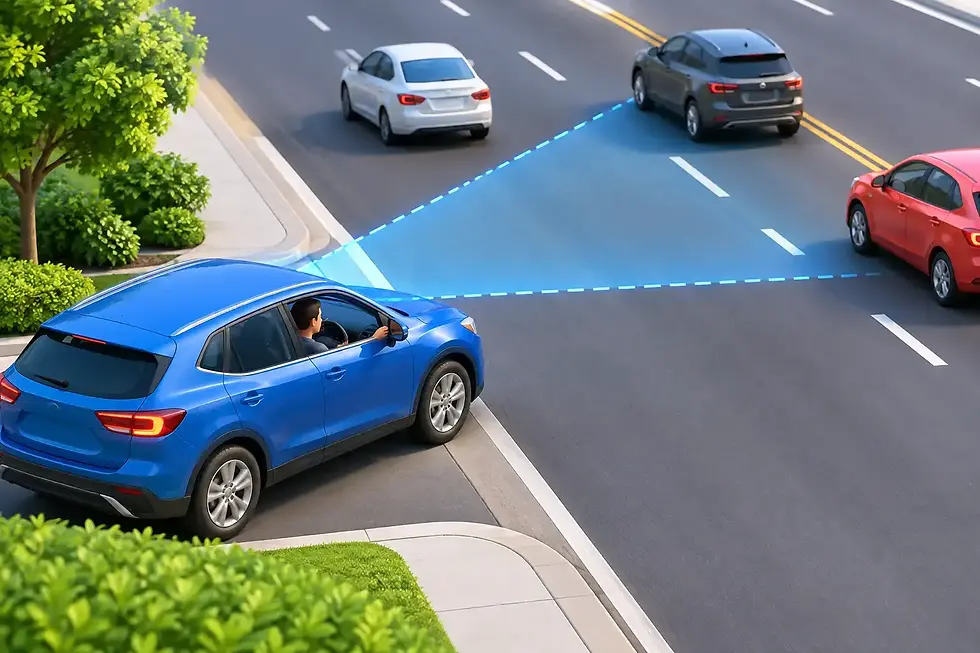
If your view is blocked by a parked ute, a large vehicle or a hedge, reduce speed and prepare to stop. You do not need to guess what is hidden. A careful, gradual approach is a sign of good judgement.
What to do when you make a mistake
Everyone takes a wrong lane or misses a turn occasionally. Do not make a risky manoeuvre to fix it. Continue safely, follow the road and find a legal place to turn around later. On a test, a missed direction is generally less serious than an unsafe decision.
The same applies if another driver behaves unpredictably. Leave space, stay calm and avoid trying to teach them a lesson with your horn or vehicle position. Defensive driving is about protecting yourself and others, even when another road user makes the mistake.
Practise intersections in stages
Start on quieter streets where you can focus on the routine without heavy traffic. Then progress to busier intersections, traffic lights, roundabouts and multi-lane turns. Repeating the same type of intersection can help, but practise in different weather, at different times and on unfamiliar roads too.
A personalised lesson can be especially helpful if one situation keeps making you anxious, such as right turns, roundabouts or judging gaps in traffic. Yes Select Driving School can tailor practice around the skills you need, using a dual-control vehicle and local test-area conditions where appropriate.
Confidence at intersections does not come from taking chances. It comes from seeing more, planning earlier and knowing that it is always okay to wait for a safe gap. Give it a go, practise the routine, and let calm decisions become your normal driving habit.


Comments