


Driving Test Criteria: What Assessors Look For
A driving test is not a reward for getting through a set of familiar streets without stalling or missing a turn. The driving test criteria are about whether you can make safe, legal and sensible decisions when conditions change. An assessor needs to see that you can manage the car, read the road and look after the people around you without being coached through every step.
That can feel like a lot when you are already nervous. The encouraging part is that safe driving is built from repeatable habits. With the right practice, the skills assessed on test day become the same skills you use every time you drive.
What the driving test criteria are really measuring
In a Victorian practical driving test, the assessor observes your driving over a range of roads and traffic situations. They are not looking for a perfect performance with no small corrections. They are looking for consistent control, awareness, judgement and compliance with road rules.
A small mistake is not always the end of a test. You may need to adjust your position slightly while parking, take an extra moment before moving off, or receive a direction late and continue safely rather than making a rushed turn. What matters is how you respond. A safe driver stays calm, checks properly and makes the next decision with care.
On the other hand, an action that creates danger, ignores a road rule or requires the assessor to intervene can have serious consequences for the result. This is why driving lessons should prepare you for more than a memorised test route. You need skills that work at any intersection, roundabout, shopping strip or residential street.
Observation needs to be visible
Good observation is one of the biggest parts of safe driving, and it needs to be clear enough for the assessor to see. You might be checking mirrors constantly, but if your head and eye movements are too subtle, it can be difficult to demonstrate that awareness.
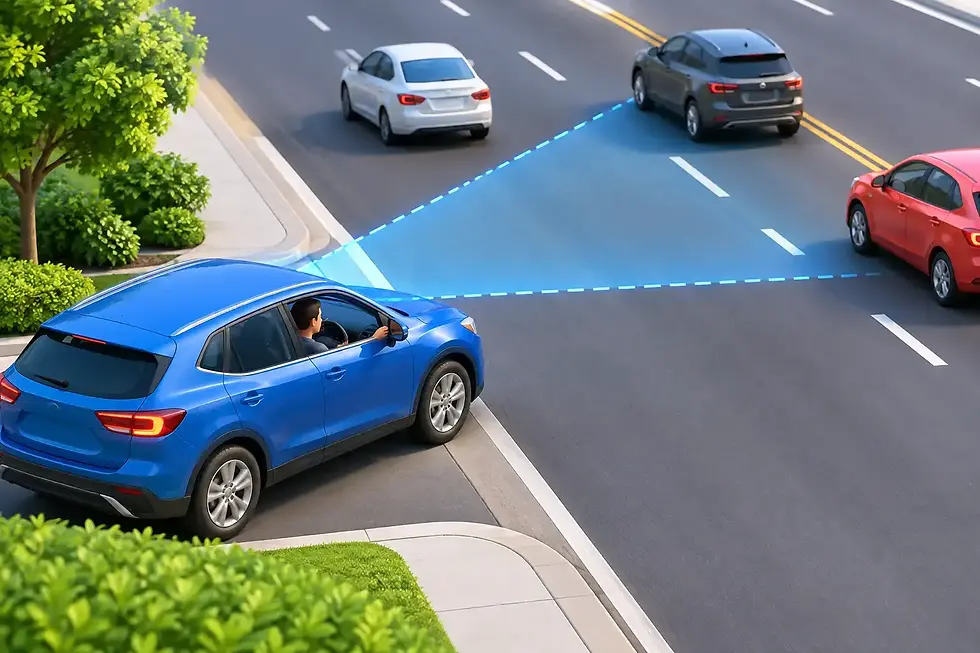
Before moving away from the kerb, check mirrors, look over the appropriate shoulder for blind spots, indicate and make sure the gap is safe. Repeat this process whenever you change lanes, merge, pull over, leave a parking space or re-enter traffic. At intersections, scan ahead and to both sides. Watch for pedestrians near crossings, cyclists travelling alongside parked cars and vehicles that may turn across your path.
Reversing requires the same attention. A reversing camera is a useful aid, but it does not replace direct observation. Keep checking around the vehicle, especially in the direction of travel, and move slowly enough to respond safely. An instructor's dual-control vehicle can provide reassurance while you practise these habits, but the aim is for you to make each check independently.
Make your checks purposeful
There is no benefit in exaggerated head movements if they are not connected to what is happening on the road. Check before you act, then act only when the situation is safe. For example, a mirror check before braking helps you understand what is behind you, while a shoulder check before changing lanes confirms the space beside your car is clear.
Speed control is more than staying under the limit
Knowing the posted speed limit is essential, but meeting the driving test criteria also means choosing a speed that suits the conditions. A legal speed can still be unsuitable if visibility is poor, the road is wet, traffic is congested or pedestrians are close to the roadway.
Aim to maintain a steady, appropriate speed rather than repeatedly drifting above and below the limit. Look well ahead so you can ease off early for red lights, roundabouts and slower traffic. Last-second braking can make passengers uncomfortable and may suggest that you are not planning ahead.
School zones, roadworks, shopping areas and narrow residential streets need particular care. Read the signs as you approach, not after you pass them. If you are unsure whether a lower limit applies, slow down safely while you assess the signs and surrounding environment.
Keeping a safe following distance matters too. Leave enough room to stop if the vehicle in front brakes suddenly. The right gap depends on speed, rain, traffic flow and visibility, so avoid treating one fixed distance as suitable for every situation.
Positioning, turns and lane choice
Assessors look for road positioning that is safe and appropriate. That includes choosing the correct lane early, keeping a sensible buffer from parked vehicles, and positioning your vehicle properly before turns.
When turning left or right, indicate in good time, check mirrors and blind spots where needed, slow smoothly and enter the correct part of the new road. On multi-lane roads, plan ahead. If you need to turn right soon, do not leave the lane change until the final few metres. If it is not safe to move across, continue on and follow the next safe opportunity. Missing a direction is usually safer than forcing your way into a gap.
Roundabouts test several skills at once: approach speed, lane selection, giving way, indication and observation. Practise reading the signs and road markings before reaching the roundabout. Enter only when the path is safe, maintain your lane through the roundabout, and indicate correctly when leaving where required.
Decision-making at intersections and hazards
A test route may include traffic lights, give-way signs, stop signs, pedestrian crossings and uncontrolled intersections. The key is not simply remembering who has priority. It is recognising when another road user may not do what you expect.
At a green light, check that the intersection is clear before proceeding. When turning right across oncoming traffic, wait for a safe gap rather than relying on another driver to slow down. At a stop sign, come to a complete stop at the correct position, observe carefully, then move only when you have enough space.
Hazard awareness also includes noticing the early signs of risk. A ball rolling from between parked cars may mean a child is nearby. A car waiting at a side street may pull out. A cyclist could move around a parked vehicle. Seeing these possibilities early gives you time to adjust gently instead of reacting abruptly.
Vehicle control should feel calm and controlled
Whether you are driving an automatic or manual, the car should respond smoothly to your inputs. Steering, braking and acceleration do not need to be flawless, but they should be controlled. Harsh braking, unnecessary acceleration and wide turns can make it harder to manage risks around you.
For manual drivers, practise finding the clutch point, selecting the right gear and moving off on hills without rushing. For automatic drivers, focus on smooth brake release, controlled acceleration and avoiding the habit of resting a foot heavily on the brake. In both cases, keep both hands ready on the steering wheel and avoid distractions inside the car.
Parking and low-speed manoeuvres are also a chance to show patience. Set up the manoeuvre slowly, observe continuously and make small corrections when needed. Rushing to complete a reverse parallel park often causes more trouble than taking an extra moment to reset your position safely.
How to practise for test day without memorising a route
Knowing the general road environments around a test centre can help you feel less unfamiliar on the day. However, relying on one exact route can leave you unsettled if the assessor takes a different street or traffic changes. Practise on varied roads, at different times and in changing conditions where appropriate.
A useful lesson should identify the particular habit holding you back. You may be capable at basic vehicle control but need more work on shoulder checks. Another learner may understand road rules well but need confidence at busy roundabouts or when merging. Tailored practice makes better use of your time than repeating the same comfortable drive.
Before the test, practise the complete sequence of a drive: adjusting your seat and mirrors, preparing the vehicle, moving away safely, following directions, recovering from an unexpected situation and parking at the end. If test-day vehicle access is part of your plan, spend enough time in that vehicle beforehand so its controls do not feel new.
For learners across Melbourne's eastern and south-eastern suburbs, practising around the types of roads used near local VicRoads test centres can be particularly helpful. It builds familiarity with lane markings, busy traffic periods and the mix of residential and main-road driving, while keeping the focus on safe decisions rather than route memory.
When nerves show up on the day
Nerves do not mean you are unready. Most learners feel them, including people who drive well in lessons. Give yourself time to arrive, use the bathroom if needed and settle into the seat before the test begins. Listen carefully to each direction and ask for it to be repeated if you genuinely do not hear it.
If you make a minor error, do not assume the test is over. Take a breath, stay focused and continue driving safely. Your next few decisions still matter. The best preparation is not trying to eliminate every feeling of anxiety. It is building safe routines that still work when you are nervous.
Give yourself permission to learn steadily, ask questions and practise the parts that feel difficult. When safe observation, calm control and thoughtful decisions become your normal driving habits, test day becomes a chance to show the capable driver you have worked hard to become.


Comments