

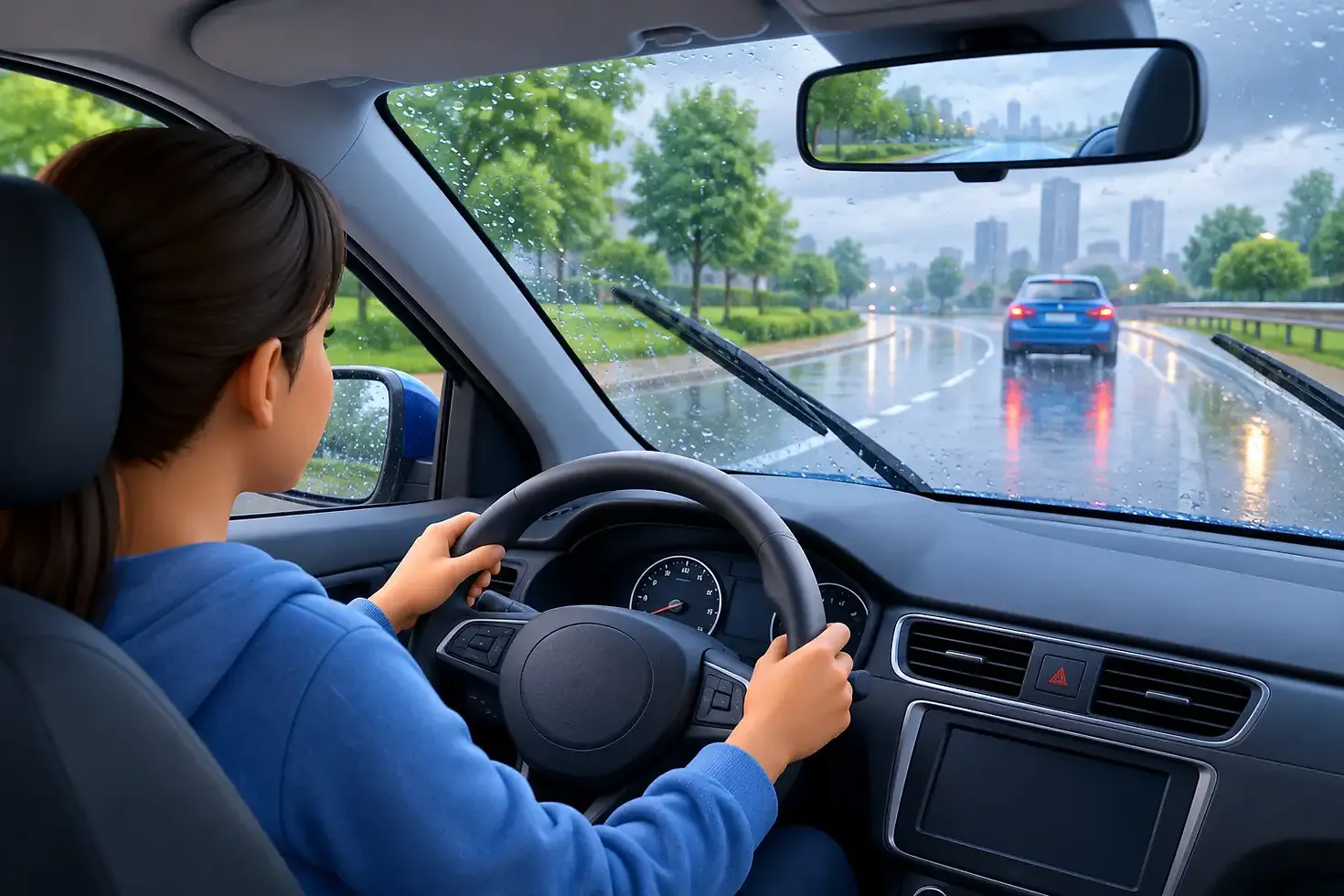
Driving in Wet Weather for Safer Learner Driving
Rain can change a familiar street quickly. A painted line becomes slippery, spray hides the lane markings and the car ahead may stop sooner than expected. For learner drivers, driving in wet weather is not about being fearless or driving overly slowly. It is about recognising reduced grip early and giving yourself the time and space to respond safely.
Wet-weather driving is a useful skill for everyday Melbourne conditions and for your driving test. You cannot control the rain, but you can control your speed, following distance, observations and steering. Those are the choices that keep a drive calm when the road surface is not at its best.
Prepare the car before you move
Good wet-weather driving starts before the car leaves the kerb. Clear fog, mist and rain from every window you need to see through. Use the demister if the windscreen begins to fog up, and check that the wipers clear the glass properly. Worn wiper blades can leave streaks that catch headlights and make night driving much harder.
Turn on your headlights whenever rain, spray or low cloud reduces visibility. This helps other road users see you, especially on busy arterial roads where spray from utes, buses and trucks can briefly block their view. Daytime running lights do not always switch on the rear lights, so use the proper headlight setting where needed.
Your tyres matter more than most learners realise. Tread channels water away from the tyre, helping it maintain contact with the road. If tyres are worn, under-inflated or damaged, the vehicle can lose grip sooner. This is one reason a professionally maintained lesson vehicle is reassuring in poor weather. At Yes Select Driving School, dual controls also allow the instructor to assist if a developing hazard needs quick action while you build judgement and confidence.
Driving in wet weather means leaving more room
The simplest adjustment is to increase your following distance. On a dry road, a safe gap gives you time to see a hazard, decide what to do and brake progressively. In rain, every part of that process can take longer. The surface may be slick, your tyres need more distance to slow the car, and spray can reduce what you see ahead.
Rather than focusing on a fixed number of car lengths, use a time gap. Pick a stationary point such as a sign or power pole. When the vehicle ahead passes it, count steadily until you reach the same point. In rain, allow at least four seconds, and more in heavy rain, darkness or stop-start traffic. If another vehicle moves into that space, calmly ease off the accelerator and rebuild the gap.
More room also helps at intersections. Do not follow the car ahead into a junction simply because the lights are green. Check that there is space beyond the intersection before entering. Wet roads can make traffic bunch up unexpectedly, and stopping over a pedestrian crossing or in the middle of an intersection creates a risk for everyone.
Brake early and progressively
Sudden braking is a common cause of skids and loss of confidence. When you see traffic slowing, lift off the accelerator early. This gives the car time to reduce speed naturally before you need the brake. Then apply smooth, progressive pressure rather than stamping on the pedal.
Modern cars are commonly fitted with anti-lock braking systems, which help prevent wheel lock under hard braking. However, they do not remove the need for safe following distance. If the system activates, keep looking where you want the car to go and maintain firm, steady brake pressure. Do not pump the brake pedal.
Plan further ahead than usual. Watch brake lights several vehicles in front, scan for queues near shopping strips and notice when traffic is approaching a roundabout or a school crossing. Early information means gentle control inputs, which is exactly what a wet road rewards.
Use smooth steering and sensible speed
The posted speed limit is the maximum permitted speed in good conditions, not a target you must reach. In heavy rain, around deep puddles, on winding roads or where visibility is reduced, a lower speed may be the safer legal choice. Drive at a speed that lets you stop within the distance you can see is clear.
Be especially careful on the first rain after a dry spell. Oil, dust and small debris can rise to the surface, making the road unexpectedly slippery. Painted arrows, tram tracks, metal covers, bridge surfaces and leaf-covered sections can also have less grip. Avoid braking, accelerating or turning sharply while travelling over them where possible.
When turning, slow down before the turn, look through the corner and use gentle steering. Accelerate smoothly only once the vehicle is settled and your wheels are returning towards straight. The same approach applies when changing lanes. Check mirrors, indicate, check the blind spot and move across steadily. Quick steering can unsettle the vehicle, particularly through standing water.
If the car begins to skid or aquaplane
Aquaplaning happens when tyres ride on a layer of water rather than gripping the road. It is more likely at higher speeds, through deep water and with poor tyre condition. The steering may feel light or vague, and the car may not respond as expected.
If this happens, stay calm. Ease off the accelerator gently, keep the steering as straight as practical and avoid sudden braking or sharp steering. As the tyres regain contact with the road, normal steering feel should return. Do not try to power through water or make abrupt corrections.
If your car skids, look in the direction you want to travel and make small, controlled steering adjustments. Take your foot off the accelerator. Avoid overcorrecting, as a large reaction can turn a small slide into a bigger loss of control. These situations are uncommon when you leave space, slow down for conditions and keep your controls smooth.
See hazards that rain can hide
Rain affects more than the road surface. Pedestrians may hurry across the road with umbrellas blocking their side vision. Cyclists can be less stable near puddles or drain grates. Motorcyclists need extra room because wet surfaces affect them more severely. Give them space and avoid driving through puddles beside them.
Large vehicles deserve special care. A truck or bus can throw up a wall of spray that removes your vision for a moment. Before overtaking, ask whether you can complete the manoeuvre with a clear view and enough room. Often, the sensible choice is to wait until conditions improve or the road opens up.
At night, wet roads reflect headlights, traffic signals and shop lights. Slow down enough to read the road surface and lane markings. Keep your windscreen clean inside and out, as glare becomes much worse through a dirty screen. If oncoming headlights are bright, look slightly to the left towards the edge of your lane rather than staring directly into the lights.
Floodwater is not a driving challenge
Never drive into floodwater just to see whether the car will get through. The depth is difficult to judge, the road underneath may be damaged and moving water can push a vehicle off line. Even shallow water can hide potholes, debris or a kerb.
Turn around and find another route if water covers the road or barriers and warning signs are in place. Do not drive around road-closed signs. This is not being overly cautious. It is a practical decision that protects you, your passengers and emergency workers.
After driving through a shallow puddle that was safe to cross, test the brakes gently when clear of other traffic. This helps dry the brake components and lets you check that the pedal feels normal. If the car feels unusual, pull over safely and seek advice rather than continuing without confidence.
Build wet-weather confidence before test day
Learners often worry that rain during a driving test will make everything harder. The core test skills stay the same: safe observation, appropriate speed, lane position, gap selection and control. The difference is that you need to show sensible adjustment to the conditions. An assessor is not looking for fast driving. They are looking for safe, independent decisions.
Practise in light rain first if possible, with a supervising driver or instructor who can give calm feedback. Start on familiar streets, then progress to busier roads, roundabouts and parking manoeuvres when you feel ready. Reversing cameras are helpful for awareness, but continue to complete proper observations. Rain on the camera lens can reduce its usefulness, and no camera replaces checking around the vehicle.
A tailored lesson can be particularly helpful for drivers returning to the road, overseas licence holders adjusting to Victorian conditions, or learners who tense up when visibility changes. The goal is not to wait for perfect weather. It is to develop a repeatable routine: prepare the car, leave space, look ahead and keep every input smooth.
The next time rain starts on your drive, give yourself permission to slow the process down. A little more space and a little more patience can turn a stressful trip into valuable practice for the capable driver you are becoming.


Comments