

Essential Car Controls Beginners Should Know
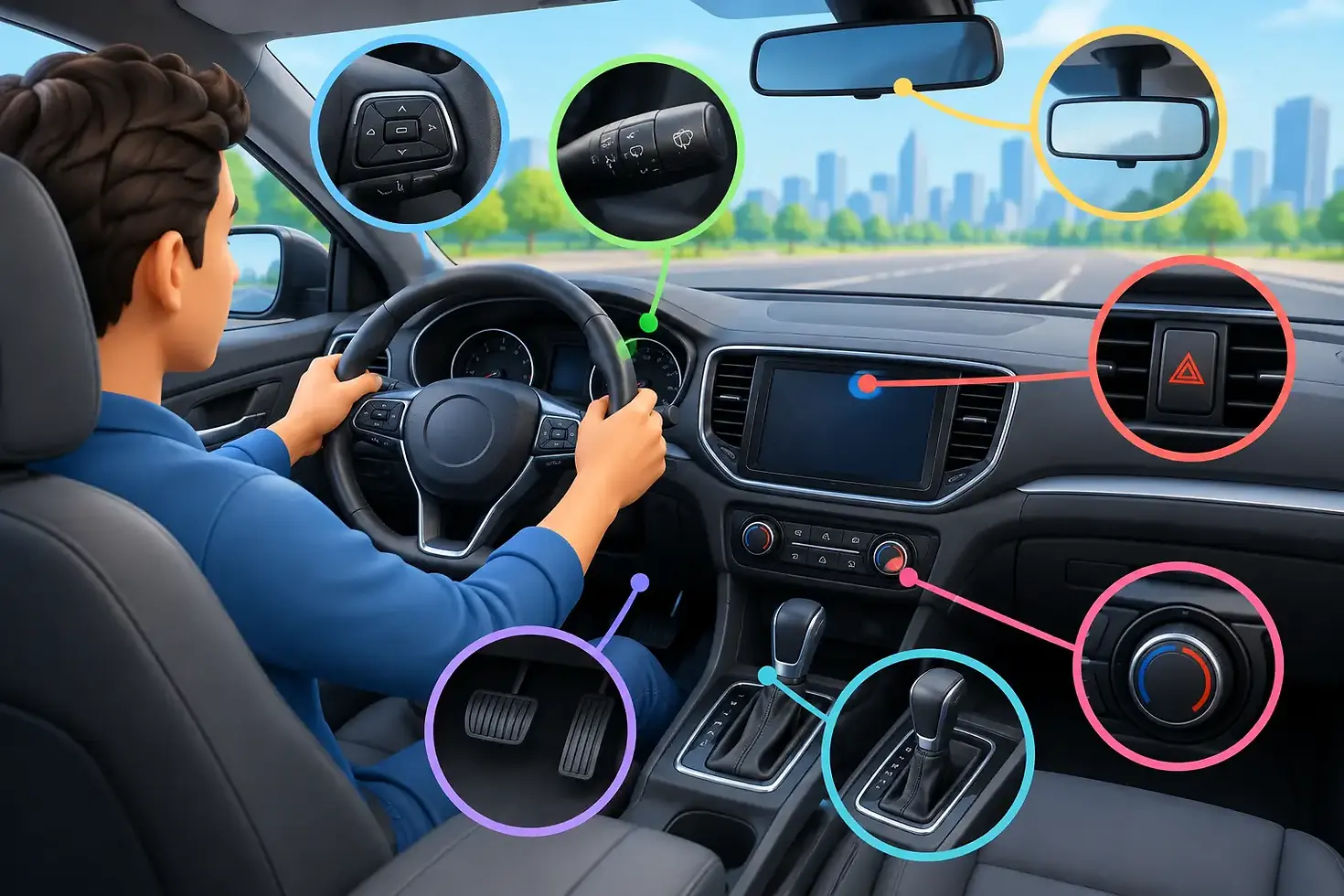
The first time you sit in the driver’s seat, the number of buttons, stalks and pedals can feel like a lot to take in. Learning the essential car controls beginners use is not about memorising every symbol at once. It is about knowing what helps you see clearly, communicate with other road users and keep the car under control before you move off.
A good driving lesson gives you time to practise each control in a calm setting. There is no need to rush. Once the controls become familiar, you can give more attention to the road, your speed and the decisions around you.
Essential car controls beginners should find first
Before starting the engine, adjust your seat so you can fully press the pedals without stretching and hold the steering wheel with a slight bend in your elbows. Adjust the interior mirror and side mirrors before driving away. You should be able to see behind and beside the vehicle with a quick glance, without leaning across the seat.
Take a moment to find the pedals. In an automatic car, your right foot operates both the accelerator and brake. The wide pedal is the brake and the narrower pedal is the accelerator. Keep your left foot resting on the footrest, not hovering over a pedal. Using two feet in an automatic can lead to sudden braking when you are still building confidence.
In a manual car, there are three pedals. From left to right, they are the clutch, brake and accelerator. The clutch lets you change gears and move off smoothly. It takes practice to coordinate the clutch and accelerator, so stalling at first is completely normal. The aim is not to avoid every stall immediately. It is to respond safely, reset the car and try again.
Gear selector or gear lever
Automatic gear selectors usually show P for park, R for reverse, N for neutral and D for drive. Some cars also have a low gear or manual mode, but these are not usually needed for early lessons. Check the dashboard or selector display before moving, particularly when reversing out of a driveway or parking space.
A manual gear lever has a pattern showing the gears and reverse. First gear is generally used to move off, while higher gears are selected as speed increases. Reverse often requires an extra action, such as lifting a collar or pressing the lever down, which helps prevent selecting it by accident.
Always apply the foot brake before moving an automatic selector out of park. In either transmission type, make sure the area is clear before selecting reverse. A reversing camera can be useful, but it does not replace looking through the rear window and checking mirrors and blind spots.
Steering wheel and dashboard information
The steering wheel controls the direction of the front wheels, but it also commonly holds buttons for audio, mobile functions or cruise control. You do not need to use these extra buttons while learning. Keep your hands focused on steering and avoid changing music or answering mobile calls while the vehicle is moving.
Your dashboard gives important information at a glance. Pay attention to the speedometer, fuel gauge and warning lights. The speedometer is especially important for learner drivers because speed limits can change quickly around schools, shopping strips and residential streets.
A warning light may appear briefly when the ignition is switched on, then go out after the engine starts. If a red warning light stays on, tell your instructor, parent or another experienced driver before continuing. Do not assume it can wait until after the trip.
Controls that help other people understand you
Safe driving is not only about controlling your own car. It also means giving other drivers, cyclists and pedestrians enough warning to respond to what you are doing.
Indicators and hazard lights
The indicator stalk is usually on the right-hand side of the steering column. Push it up for a right turn and down for a left turn. Use indicators before turning, changing lanes, pulling away from the kerb or leaving a roundabout. Give them early enough that other road users can understand your intention, but not so early that they think you are turning somewhere else.
After a turn, the indicator often cancels itself as you straighten the steering wheel. Still check that it has switched off. This matters after gentle bends, lane changes and roundabouts, where it may remain on without you noticing.
Hazard lights make all indicators flash together. They are for warning other road users that your vehicle is stopped or creating an unexpected hazard, such as a breakdown. They are not a substitute for careful parking, and they do not make it acceptable to stop where stopping is unsafe or prohibited.
Horn and windscreen washers
The horn should be used briefly to warn someone of immediate danger, not to express frustration. A quick warning can help if another driver starts moving into your lane without seeing you. Leaning on the horn because someone is slow at the lights rarely improves the situation.
Windscreen washers and wipers are normally operated from a stalk near the steering wheel. Learn the settings for intermittent, low and fast wiping, as well as how to spray washer fluid. A dirty windscreen can be surprisingly distracting when the sun is low or rain starts falling. If visibility is poor, deal with it before it becomes a problem.
Lights, demisters and clear vision
The headlight controls may be on a stalk or a dial on the dashboard. Your car may have automatic lights, but do not rely on them blindly. Automatic systems may not switch on in heavy rain, fog or low winter light when you still need to be visible to others.
Use headlights from sunset to sunrise and whenever conditions make it difficult to see clearly. In Victoria, you must also use headlights in hazardous weather conditions that reduce visibility. Daytime running lights are helpful, but they may not turn on the rear lights, so check what your vehicle is doing.
High beam gives you a longer view on dark roads, but it can dazzle other road users. Dip your headlights when approaching another vehicle or following one closely. For most learner driving in built-up Melbourne suburbs, normal headlights are the appropriate setting.
Front and rear demisters clear fog or moisture from the glass. The front demister directs warm air towards the windscreen. The rear demister uses fine heating elements in the rear window and may switch off automatically after several minutes. Use the air-conditioning setting as well if needed, as it helps remove moisture from the air. Never drive with a misted-up windscreen just because you are close to home.
Parking brake, reverse and low-speed control
The parking brake may be a handbrake lever, a foot-operated pedal or an electronic switch. Its job is to hold the vehicle still when parked. In a manual car, it is also useful when moving off uphill, as it can prevent rolling backwards while you find the clutch bite point.
Before releasing the parking brake, make sure you are in the correct gear, have completed your observations and are ready to move. Before applying it at the end of a drive, stop fully with the foot brake first. In an automatic, select park once you have stopped securely. In a manual, select neutral and apply the parking brake, then follow the vehicle manufacturer’s guidance for parking on slopes.
Reversing is slow-speed driving, but it needs full concentration. Start by checking mirrors, looking over your shoulder through the rear window and checking blind spots where needed. A camera and parking sensors support your observation, yet they cannot show every cyclist, child, bollard or low obstacle.
Build the habit before the test
For driving test preparation, assessors expect you to use controls safely without needing prompts. That does not mean every action has to look dramatic. Smooth, timely use is better than exaggerated movements. Check mirrors with purpose, indicate at the right time and keep your attention ahead rather than staring at the dashboard.
Different cars place controls in slightly different positions. This is one reason it helps to spend the first few minutes of a lesson becoming familiar with the instructor’s vehicle. At Yes Select Driving School, learners can practise in a dual-control vehicle with a reversing camera, giving them room to learn these actions with guidance and an added safety margin.
If one control still feels confusing, say so before driving away. Ask to practise it while parked, then use it on a quiet street. Small, repeated practice turns a row of unfamiliar switches into routine, and routine gives you the calm attention needed to make safer choices on the road.


Comments